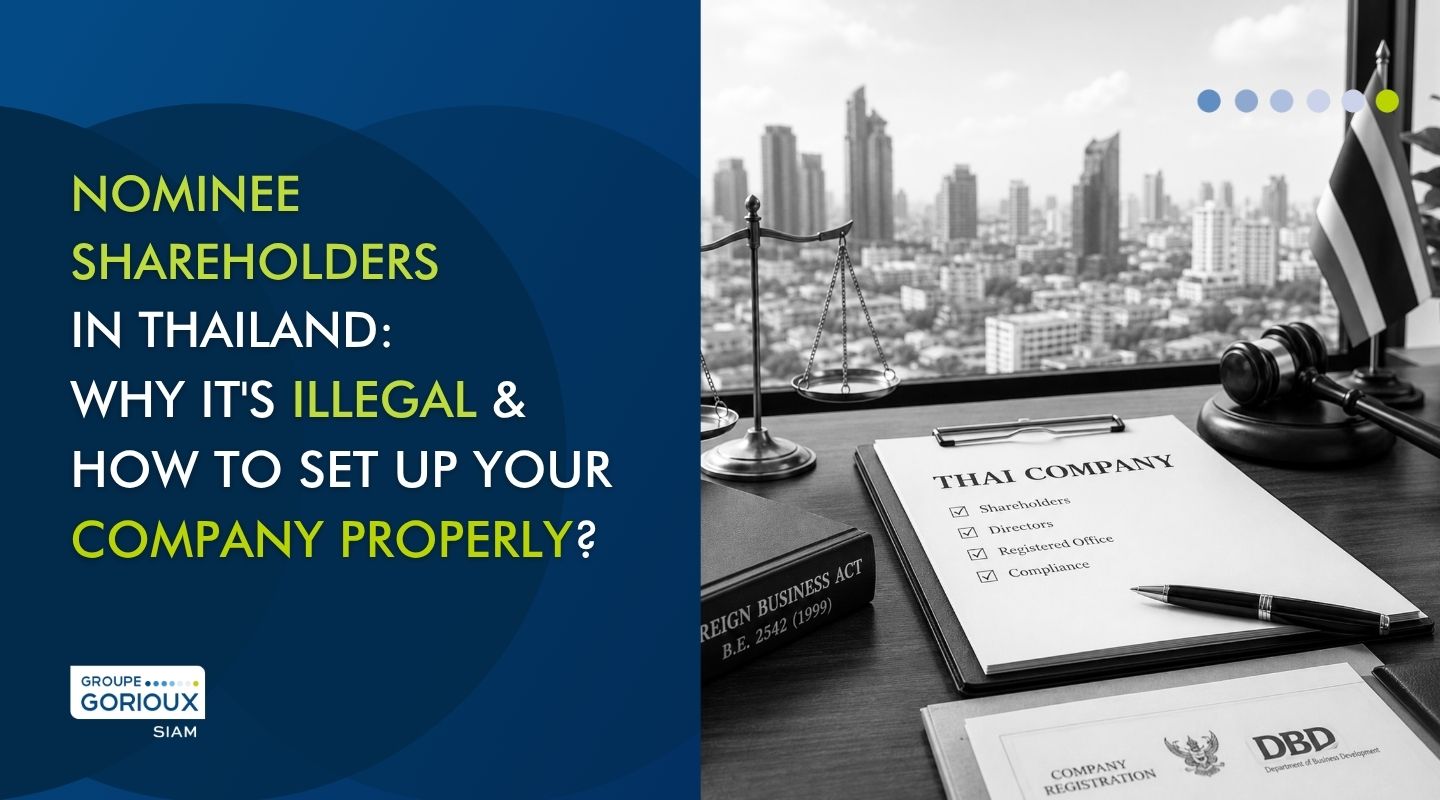
For many foreign entrepreneurs looking to establish a business in Thailand, the question of ownership arises very early in the process. Some investors hear about so-called “nominee shareholder” arrangements, whereby Thai nationals hold shares on behalf of a foreign investor in order to comply, at least on paper, with foreign ownership restrictions.
These arrangements are often presented as common market practice, or as a practical solution for businesses that do not qualify for BOI promotion. Their widespread use, however, should not be confused with legality. Under Thai law, nominee structures are prohibited and can expose both the foreign investor and the Thai shareholder to significant legal consequences.
What Is the Foreign Business Act?
Foreign ownership restrictions in Thailand are primarily governed by the Foreign Business Act B.E. 2542 (1999), known as the FBA. As a general rule, a company is considered foreign when foreign shareholders own 50% or more of its share capital.
The FBA classifies restricted business activities into three categories:
- List 1: activities reserved exclusively for Thai nationals, including newspaper publishing, rice farming and land trading. Generally closed to foreign participation.
- List 2: activities related to national security, culture, natural resources and certain strategic sectors. Foreign participation may be permitted, but only with prior Cabinet approval.
- List 3: a broad range of commercial and service activities where foreign investors may participate, but only after obtaining a Foreign Business Licence (FBL).
In practice, many sectors foreign entrepreneurs commonly consider (service businesses, restaurants, tourism, retail and real estate) are affected by these restrictions. Some investors are therefore tempted to use nominee shareholders to create the appearance of Thai majority ownership. This is precisely where legal risks arise.
.

.
What Is a Nominee Shareholder and Why Is It a Problem?
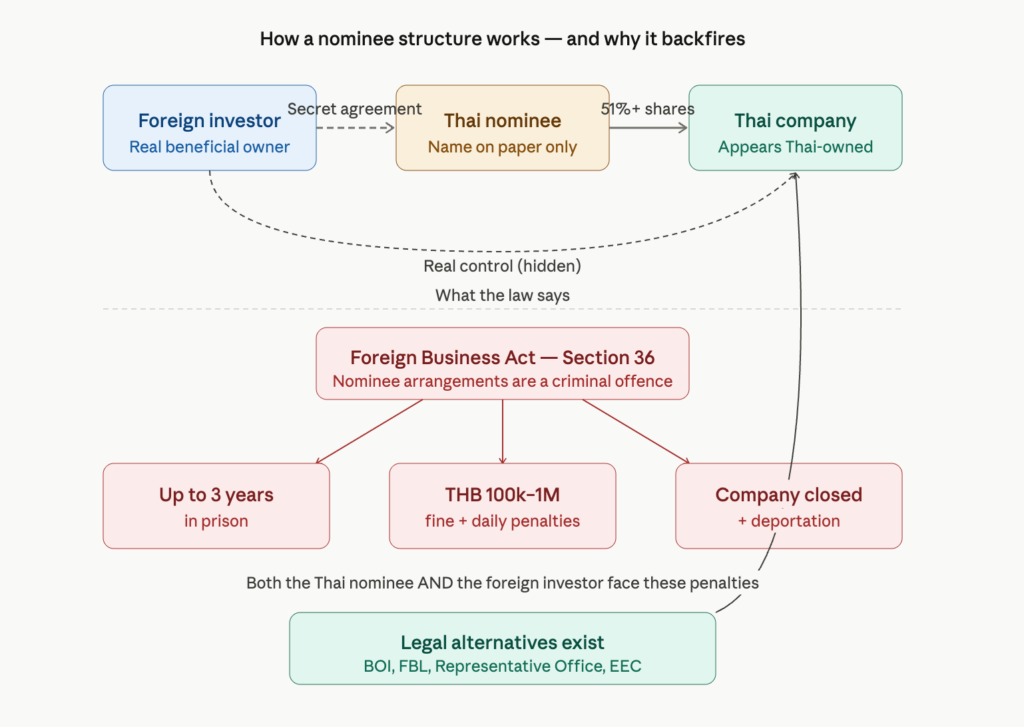
A nominee shareholder is a Thai individual who holds shares in a company on behalf of a foreign investor, without having a genuine economic interest in the business. Although the corporate records suggest the company is majority Thai-owned, the reality is often different: the foreign investor finances the business, makes the strategic decisions and retains effective control.
Rather than simply reviewing the share register, authorities look much deeper. They examine the origin of funds. They look at the actual role played by the Thai shareholder. Dividend distributions, voting rights and day-to-day management are all scrutinised. Ultimately, one question matters: who genuinely owns, finances and controls the business.
What Authorities Actually Look At
When reviewing a company’s ownership arrangements, regulators may seek to understand:
- who financed the acquisition of the shares
- whether Thai shareholders have the financial capacity to make the investment attributed to them
- who exercises effective control over the business
- how profits are distributed
- whether shareholders actively participate in corporate decision-making
For foreign investors, this means compliance can’t be assessed solely by reviewing the shareholding percentages in the company’s registration documents. Demonstrating genuine investment, effective participation and transparent funding sources is just as important as meeting formal ownership requirements.
To establish genuine shareholding, companies should be in a position to produce:
- traceable payment records showing the Thai shareholder’s actual financial investment
- properly executed share transfer documents
- dividend payment records demonstrating real profit distribution
- shareholder meeting minutes showing genuine participation in decisions
- bank statements or financial records proving the Thai shareholder had the means to make the investment
The Legal Consequences
Section 36 of the FBA expressly prohibits arrangements intended to circumvent foreign ownership restrictions. Where authorities determine that a nominee arrangement has been used, both the foreign investor and the Thai nominee face criminal liability. The penalties should not be underestimated:
- Up to 3 years in prison
- Fines between THB 100,000 and THB 1,000,000
- Daily fines of THB 10,000 to THB 50,000 if the arrangement continues after a court order
- Forced dissolution of the company
- Deportation of the foreign national involved
While the legal framework itself has remained unchanged, its practical enforcement has intensified considerably in recent years.
.
.
The Crackdown on Nominee Structures Is Intensifying
One misconception we still regularly encounter is the belief that nominee structures remain largely tolerated, particularly when they don’t attract attention. That assumption is becoming increasingly difficult to defend.
Over the last few years, Thai authorities have devoted more resources to identifying arrangements that may conceal foreign ownership. Cooperation between the Department of Business Development (DBD), the Department of Special Investigation (DSI), the Anti-Money Laundering Office (AMLO) and the Royal Thai Police has increased and investigations are no longer limited to reviewing company registration documents.
Key Figures Since 2024
The numbers put the scale of these efforts into perspective:
- More than 46,000 companies identified for further review across several provinces
- Over 860 cases formally prosecuted between September 2024 and May 2025
- Estimated economic impact of approximately THB 15 billion from those cases alone
On 1 January 2026, DBD Order No. 2/2568 came into force. Thai shareholders in companies involving foreign participation must now provide bank statements proving that the funds used to acquire their shares originate from their own resources. According to the DBD, this single requirement led to a 65% reduction in attempted nominee registrations.
Further measures remain under consideration. In early 2026, the DBD met with representatives from 17 law firms to discuss additional mechanisms aimed at strengthening oversight of corporate ownership structures.
How Suspicious Structures Are Identified
The DBD has also implemented the Intelligence Business Analytics System (IBAS), an analytical tool designed to flag patterns that may justify further investigation:
- the same Thai individual appearing as a shareholder in many unrelated companies
- Thai shareholders whose professional background bears no apparent connection to the business in which they have invested
- Thai individuals who do not participate in shareholder meetings or receive economic benefits consistent with their ownership interests
The existence of one of these factors does not automatically establish a nominee arrangement. But it can prompt additional enquiries and require companies to demonstrate that their ownership structure reflects genuine commercial participation.
.

.
It’s Not Just New Companies at Risk
Worth noting: these controls do not only concern newly incorporated companies.
Businesses that have operated for several years are not exempt either. Routine corporate changes can trigger scrutiny: appointing a new director, modifying signing authority, or filing amendments with the DBD. In these situations, authorities may request supporting documentation on the ownership structure and the source of funds invested by shareholders.
Any companies that have historically relied on nominee arrangements should not assume that a subsequent administrative change will resolve their exposure. Such filings may instead provide an opportunity for the authorities to review the underlying ownership arrangements in greater detail.
How Can Foreigners Legally Own a Business in Thailand?
Foreign investors are not limited to choosing between full Thai ownership and a nominee arrangement. Thailand offers several legal frameworks that allow foreign entrepreneurs to establish and operate businesses while remaining fully compliant.
Partner with a Genuine Thai Shareholder
For most small and medium-sized businesses, a genuine partnership with one or more Thai investors remains the most practical solution and arguably the most important piece of advice.
Genuine is the key word here. Thai shareholders are expected to contribute capital, participate in the business and share both the risks and the rewards. Rather than finding someone to tick a compliance box, the goal is to build a real commercial relationship with someone who is truly invested in the project. A strong local partner also brings valuable market knowledge, networks and insight into the local business environment. It takes time but it creates a far more stable foundation than attempting to replicate control through an illegal nominee arrangement.
.

.
BOI Promotion
The Board of Investment (BOI) romotes investment in sectors aligned with Thailand’s national development strategy. BOI-promoted companies may benefit from 100% foreign ownership, corporate tax exemptions of up to 13 years, import duty relief on machinery and raw materials, land ownership rights and streamlined work permit processes.
BOI incentives are often associated with manufacturing and tech businesses but the range of eligible activities is much broader. It includes digital services, business outsourcing, agri-tech, green energy and regional headquarters.
Foreign Business Licence (FBL)
For businesses on List 3 of the FBA that do not qualify for BOI promotion, a Foreign Business Licence provides a lawful route to majority or full foreign ownership. The application goes through the Ministry of Commerce’s Foreign Business Committee and typically takes three to six months.
Investors must demonstrate the economic value of their project and its contribution to Thailand’s economy including factors such as employment creation, level of investment, know-how transfer and commercial benefits. Approval is not automatic. But for projects that can make that case, the FBL remains a well-established and legally robust option.
Representative Office
A Representative Office allows a foreign company to establish a local presence in Thailand for non-commercial purposes: market research, supplier coordination and support for the parent company. It cannot generate revenue within Thailand, but it can be 100% foreign-owned and it’s a practical first step for companies wanting to explore the market before committing to full operations.
.

.
Eastern Economic Corridor (EEC)
The Eastern Economic Corridor is a special investment zone covering the provinces of Chonburi, Rayong and Chachoengsao. Companies in targeted industries investing within the EEC can access enhanced BOI incentives on top of the standard package, particularly relevant for manufacturing, logistics, advanced technology and infrastructure projects.
US-Thailand Treaty of Amity
American investors have an additional card to play: the Treaty of Amity (1966). Under this treaty, US citizens and US-majority-owned companies can operate in Thailand almost like a Thai entity, with majority or full ownership in most sectors. A few activities remain excluded: agriculture, land transportation and media. For most service-based and commercial businesses, however, the treaty remains a significant advantage.
Choosing the Right Structure
There is no universal solution. The appropriate structure depends on the nature of the business, the investor’s nationality, the expected level of investment, operational requirements and long-term objectives.
A manufacturing company exporting internationally will face different regulatory considerations from a restaurant in Bangkok or a software business in Chiang Mai. Certain frameworks, such as the US-Thailand Treaty of Amity, are only available to specific categories of investors.
Ownership and corporate structuring should ideally be addressed before incorporation, not after problems emerge. Correcting an unsuitable structure once a business is operational is almost always more complex, more expensive and more disruptive than getting it right from the outset.
Conclusion
Nominee shareholder arrangements have long been viewed as a practical workaround. They have never been permitted under Thai law. Recent enforcement initiatives make that clear.
Thailand offers legitimate pathways for foreign investment. A genuine Thai partnership, BOI promotion, a Foreign Business Licence or another authorised structure, foreign investors have real options for establishing compliant operations here.
Seeking professional advice at the start of a project is the most effective way to identify the right structure and avoid unnecessary risks down the line. At Gorioux Siam, we assist foreign entrepreneurs and international businesses in structuring their investments and establishing compliant operations in Thailand.