

It’s one of the questions foreign entrepreneurs ask most when setting up in Thailand. And one of the most misunderstood. Local partner, nominee, Thai shareholder… the terms get mixed up, and so do the assumptions. The result: decisions made too fast, sometimes on the wrong side of the law, and usually at the expense of the project itself.

What does Thai law say?
The Foreign Business Act (FBA), in force since 1999, governs foreign participation in Thai business. It regulates companies owned, in whole or in part, by non-Thai nationals. A purely Thai-owned business falls outside its scope entirely. Most Thai nationals go about their business without ever needing to know it exists.
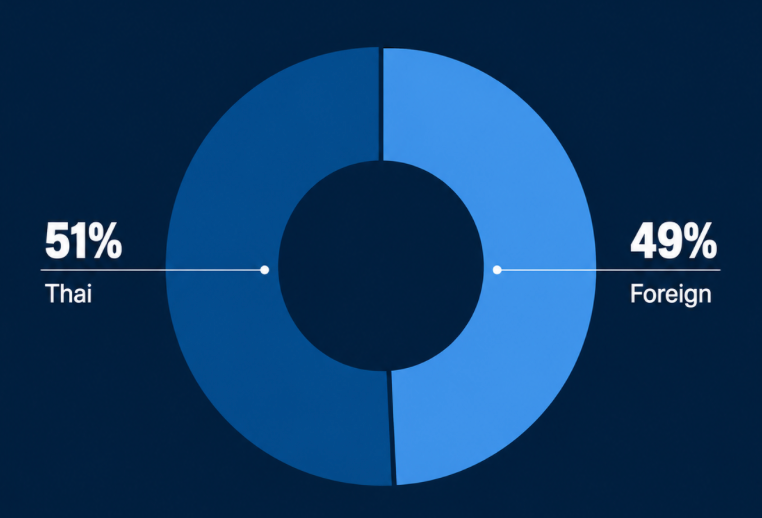
Its core principle: in most business sectors, a company is considered “foreign” as soon as non-Thai nationals hold 50% or more of its capital. In practice, this means a foreign entrepreneur setting up a standard Thai company can legally hold only 49% of the shares. The remaining 51% must be held by Thai nationals.
The FBA divides business activities into 3 lists based on the level of restriction, and each list reflects a different policy objective.
List 1 covers sectors entirely closed to foreigners, for reasons of national security and the preservation of Thai culture and natural resources: print media, agriculture, land trading.
List 2 imposes specific conditions, including a minimum 40% Thai participation. These restrictions are rooted in the same logic, national security and cultural preservation, and cover activities such as domestic transportation and certain arts and craft businesses.
List 3, the most common for investors, covers sectors where a foreign business licence (FBL) can be applied for. These restrictions exist to give Thai nationals room to build competitiveness in sectors where they are not yet considered ready to compete with foreign operators, a way of protecting local employment while still allowing the economy to grow.
Enforcement of the FBA has tightened significantly in 2026. New rules introduced enhanced documentation requirements when creating a company or changing its shareholders, giving authorities more concrete evidence to assess whether real control is being exercised by a non-Thai party. The “actual control” principle itself isn’t new, a company could already be reclassified as foreign before 2026 if its Thai shareholders weren’t found to be genuine. What changed is the toolkit: enforcement is now stricter, more systematic, and backed by documentary checks that didn’t exist before.
The difference between a Local Partner and a Nominee
Faced with the 51% rule, some foreign entrepreneurs have long looked for the easy way out: finding Thai nationals willing to appear on the shareholder register without actually investing or getting involved. That’s what’s known as a nominee arrangement.
Thai law prohibits it explicitly. Section 36 of the FBA sanctions any Thai national who agrees to act as a nominee for a foreign investor. The penalties are up to 3 years in prison and a fine of between 100,000 and 1,000,000 baht, for both the Thai national and the foreigner, along with the forced termination of the illegal structure and its business operations. For the foreigner, the consequences often go further: visa cancellation, deportation, and blacklisting from future business activity in Thailand. The Department of Business Development has been enforcing this more strictly since 2024, taking legal action in over 820 cases of suspected nominee arrangements across the country. Thailand’s regulators have made their position clear.
In practice, a nominee is someone who holds shares in a partly foreign-owned company without actually investing in it, without the financial means to do so, and without any real stake or control in the business. A legitimate local partner is the exact opposite: someone who invests real capital, assumes genuine shareholder responsibilities, and has a stake in whether the business succeeds or fails.
.

When a local partner is a genuine asset
So does every foreign company need a Thai shareholder? Not necessarily, but it remains the most common route for foreign investors, and in certain sectors, bringing in the right local partner is a smart strategic decision, not just a legal workaround. An experienced Thai partner can open doors that take foreigners years to reach on their own: established business networks, credibility with public bodies, a working knowledge of how administrations actually function. In relationship-driven sectors like real estate, distribution, or B2B services, that advantage can determine the pace of the entire project.
That said, a partnership isn’t something you structure on the fly. A Thai-majority company does not mean that governance arrangements cannot be carefully structured. Shareholders can legitimately agree on decision-making processes, board composition, reserved matters and mechanisms to resolve disputes, provided that these arrangements reflect a genuine commercial partnership and comply with Thai law. Proper documentation from the outset helps ensure transparency, predictability and the long-term stability of the business relationship.
Also, a Thai shareholder isn’t just a legal requirement in some structures. They’re also long-term business partners. A poorly chosen partner can slow down key decisions, block shareholder resolutions, refuse to approve changes in the company, or create difficulties if the relationship deteriorates. In more complex situations, events such as a divorce, death, bankruptcy, or the sale of shares can also have significant consequences if they weren’t anticipated from the start.
This is why legal protection matters as much as the choice of partner itself. A well-drafted shareholders’ agreement, clear governance rules, appropriate voting rights, and carefully defined exit mechanisms all help reduce uncertainty. Together, they protect all parties over the long term.
The objective isn’t to control your local partner, but it is to ensure that everyone knows the rules before the business starts.

.
Structures that allow 100% foreign ownership in Thailand
What many entrepreneurs miss: a local partner often isn’t required at all. Legal structures exist that allow full foreign ownership, built directly into Thai law.
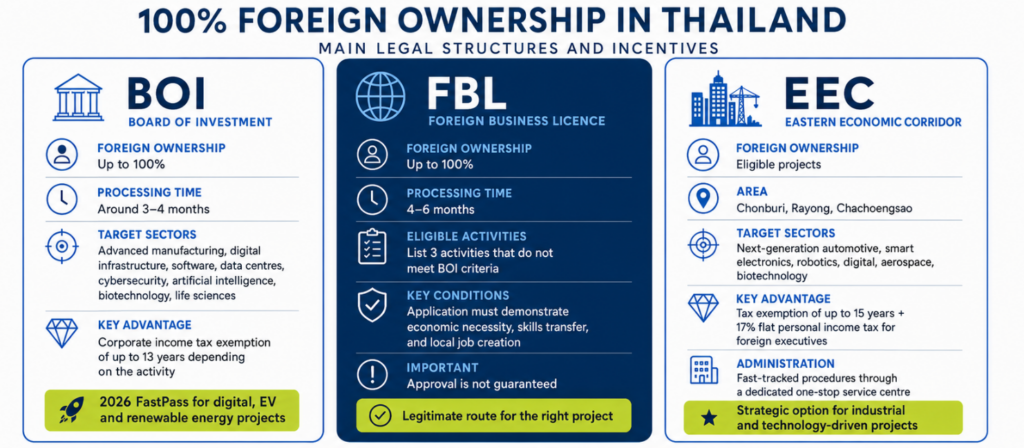
The BOI – Board of Investment
Companies with BOI promotion status can, in many cases, have foreigners holding 100% of the capital, along with corporate income tax exemptions of up to 13 years depending on the activity. The BOI prioritises high-value industries: advanced manufacturing, digital infrastructure, software, data centres, cybersecurity, artificial intelligence, biotechnology, and life sciences.
Processing time runs around 3 to 4 months. For projects in digital, electric vehicle, and renewable energy sectors, Thailand launched the “Thailand FastPass” programme in 2026 to speed up the transition from approval to operational status.
The Foreign Business Licence (FBL)
For List 3 activities that don’t meet BOI criteria, the FBL allows a foreigner to hold 100% of a company in an otherwise restricted sector. Processing takes 4 to 6 months, and approval isn’t guaranteed. The application must demonstrate economic necessity, skills transfer, and local job creation. It takes longer than the BOI route, but for the right project, it remains a legitimate one.
The EEC – Eastern Economic Corridor
The EEC is a special economic zone covering 3 eastern provinces: Chonburi, Rayong, and Chachoengsao. For eligible projects, it offers tax exemptions of up to 15 years, a flat 17% personal income tax rate for foreign executives, and fast-tracked administrative procedures through a dedicated one-stop service centre.
The EEC targets specific sectors: next-generation automotive, smart electronics, robotics, digital, aerospace, biotechnology, and is a particularly compelling option for industrial or technology-driven projects with significant investment requirements.
A development worth watching in 2026
Thailand’s Ministry of Commerce and Department of Business Development have been actively working to loosen selected FBA restrictions. One proposal under discussion would remove ten business categories from List 3, including telecommunications services, treasury centre operations, and software development. This would open them to 100% foreign ownership without an FBL. Separately, in May 2026 the Cabinet approved in principle two further draft measures: one easing restrictions on agricultural forward trading, another exempting eight additional service activities from List 3 licensing requirements. Both are now moving through legislative review ahead of official publication, with no confirmed effective date yet. Nothing is final, but the direction is clear. The market is gradually opening up.
.
What this means for your project
The right structure depends entirely on what you’re building: which sector, what level of investment, which nationality, what you need the business to look like in five years.
Most investors we speak with have already decided they need a Thai partner before they’ve read a single line of the FBA.
Gorioux Siam analyses your project and advises on the right structure, with or without a local partner, always within the legal framework. Get in touch for an initial conversation.