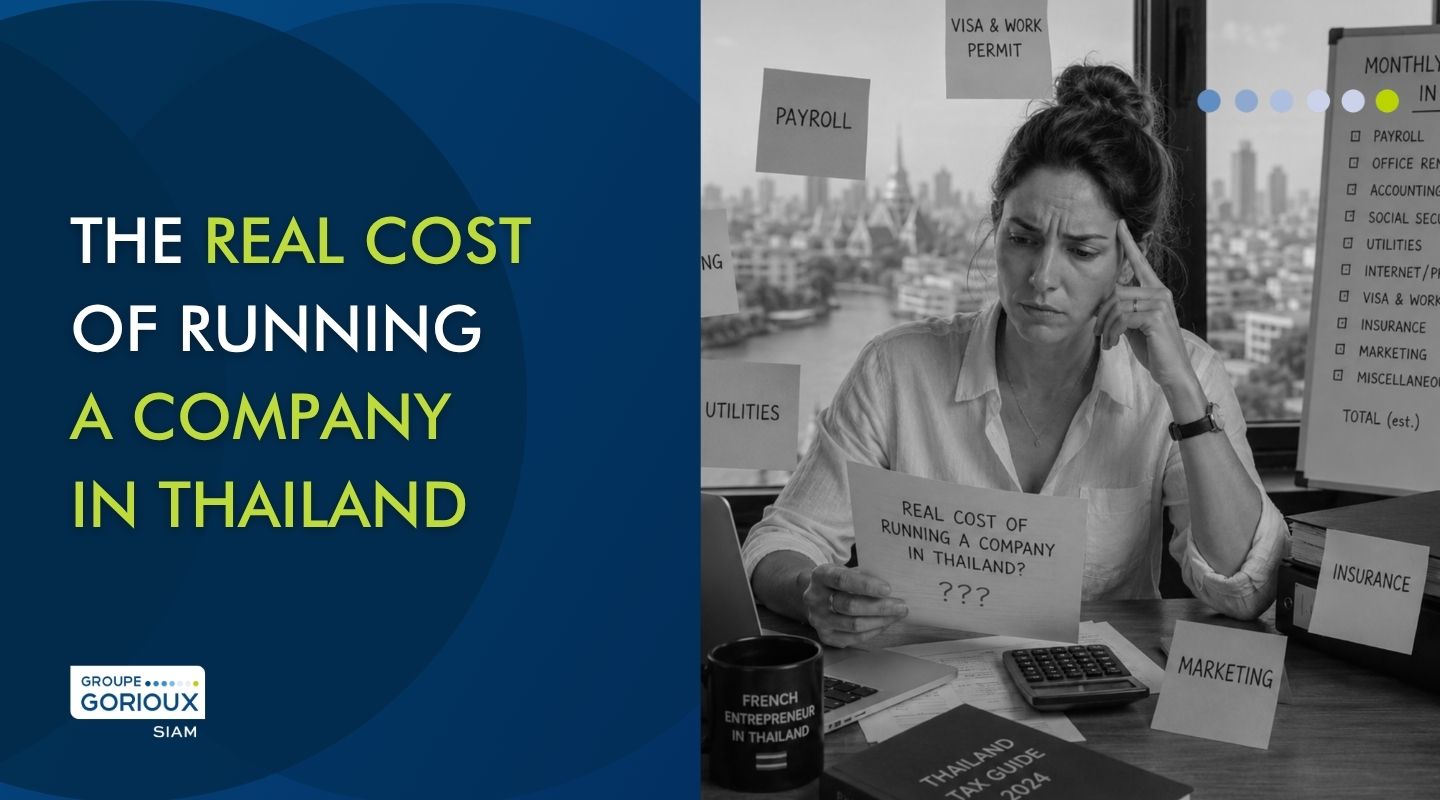
How much does it really cost to run a small company in Thailand every month? If you ask 10 entrepreneurs, you may get 10 different answers. Some will tell you THB 50,000 is enough. Others will insist you need several hundred thousand baht before paying yourself. The problem is that most calculations mix very different things: company registration, registered capital and operating expenses frequently end up in the same budget. Yet once the company exists, the real question becomes much simpler: what is the real cost of running a company in Thailand every month?
For a small service company, the answer can be surprisingly reasonable. But salaries are only the beginning. Accounting, social security, office costs, visas, work permits and annual compliance all add up. So, rather than looking at the cost of creating a company, let’s look at the cost of actually running one.
What do we mean by a “small company”?
There is obviously no single monthly figure that applies to every Thai business. A restaurant, consultancy and import company have completely different cost structures.
For this article, we’ll consider a common scenario: a small service company based in Bangkok, with 5 employees and limited physical infrastructure. The company has no inventory, factory, company vehicles, or expensive machinery. This distinction matters because payroll will usually represent the largest expense. Once inventory or substantial premises enter the picture, the calculation changes considerably. We are also separating registered capital from operating costs. Registered capital may be necessary for the company structure or foreign work permits, however, it is not a monthly expense.
The monthly budget
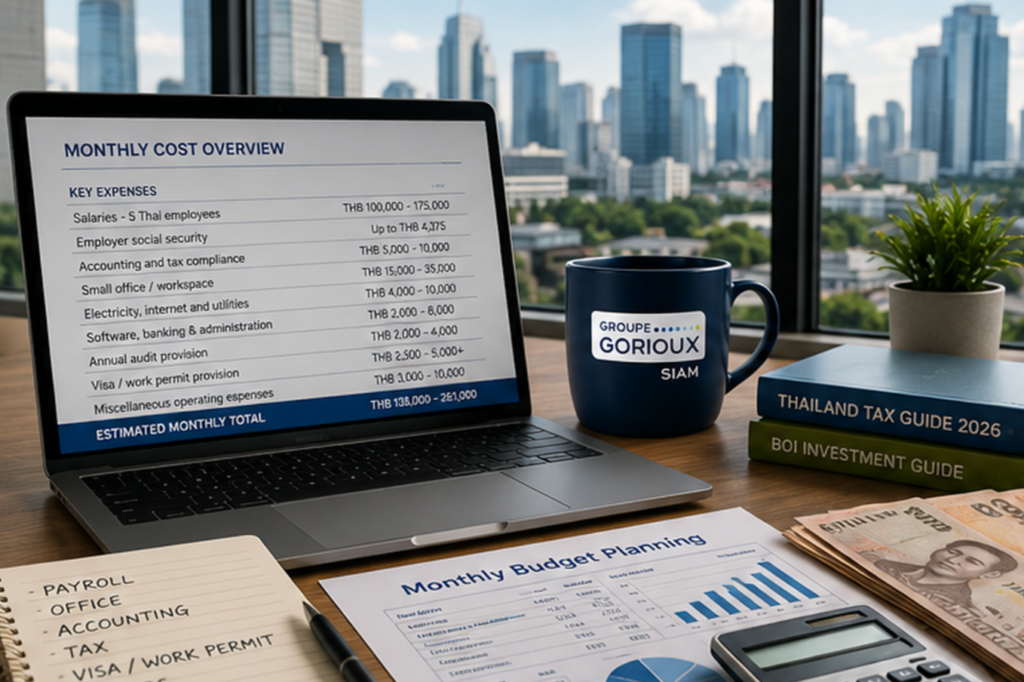
Before looking at each expense, here is a working budget for our example company.
| Expense | Typical monthly budget |
| Salaries – 5 thai employees | THB 100,000 – 175,000 |
| Employer social security | Up to THB 4,375 |
| Accounting and tax compliance | THB 5,000 – 10,000 |
| Small office / workspace | THB 15,000 – 35,000 |
| Electricity, internet and utilities | THB 4,000 – 10,000 |
| Software, banking and administration | THB 2,000 – 8,000 |
| Annual audit provision | THB 2,000 – 4,000 |
| Visa / work permit provision | THB 2,500 – 5,000+ |
| Miscellaneous operating expenses | THB 3,000 – 10,000 |
| Estimated monthly total | Around THB 138,000 – 261,000 |
These figures are not statutory rates, they are a working budget based on published benchmarks and common operating expenses. They also exclude corporate income tax, marketing, inventory and the founder’s remuneration. If we add those elements, the monthly requirement can increase quickly.
The important number is therefore not THB 138,000 or THB 261,000, but what sits behind those figures.
Payroll is where the real cost begins
Usually, for most small service companies, payroll dominates the monthly budget. Thailand’s minimum wage should not be used as a realistic benchmark for qualified office employees. Since July 2025, Bangkok’s statutory minimum wage has been THB 400 per day. Actual salaries for accountants, salespeople, marketers and administrative staff will generally be higher.
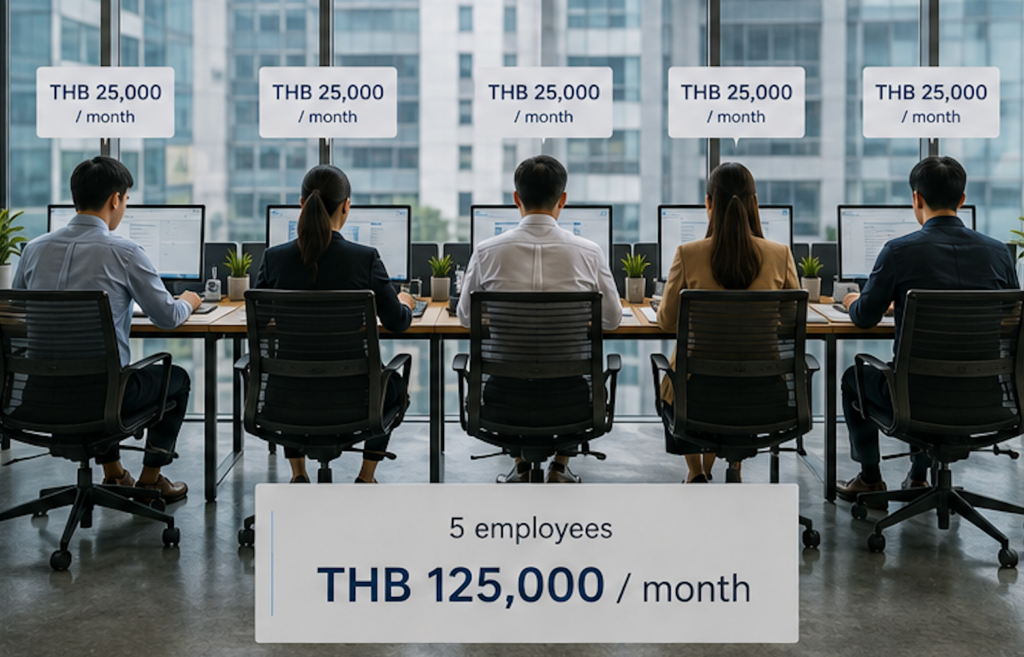
A 5-person team averaging THB 25,000 per employee already creates a THB 125,000 monthly payroll. Increase that average to THB 35,000 and the figure becomes THB 175,000. And this still does not necessarily represent the company’s full payroll cost. If the founder is actively working in the business and draws a salary, that remuneration also needs to be factored in. We have kept it outside the figures above, as founder salaries vary too widely from one company to another to use a meaningful standard amount.
Then comes social security. From January 2026, Thailand increased the maximum salary base used for Social Security Fund contributions to THB 17,500. Employers and employees each contribute 5%. The maximum employer contribution is therefore THB 875 per employee each month. For 5 employees above the ceiling, the company pays THB 4,375 monthly. Hiring 2 additional employees at THB 30,000 each will have a much bigger impact on your costs than switching accounting providers or finding a cheaper internet plan. For a small company, it makes more sense to focus first on the expenses that have the greatest impact on the monthly budget.
Accounting is not an annual expense
One common mistake is treating accounting as something that happens when annual accounts are prepared. Thai companies have recurring accounting and tax obligations throughout the year. Depending on their activities, these can include withholding tax, payroll reporting, social security and VAT filings. VAT registration becomes mandatory once taxable annual turnover exceeds THB 1.8 million, and VAT-registered companies must file VAT returns monthly.
For a small company, monthly accounting and bookkeeping services commonly represent several thousand baht. A reasonable working range is around THB 5,000 to THB 10,000 monthly, although the amount can rise with transaction volume, employee numbers, VAT complexity or international operations.
Then there is the year-end work. Thai limited companies need annual financial statements to be prepared and audited. This means budgeting both for the accounting work involved in preparing the financial statements and for the statutory audit itself. Rather than treating these as surprise costs once a year, it makes sense to set some money aside for them each month. Even a company with very little activity still has ongoing compliance costs. A dormant company may be cheap to run, but it isn’t free.
Your THB 20,000 office rarely costs THB 20,000
Thailand’s Board of Investment publishes Bangkok office rental benchmarks. Its indicative rate for CBD office space is around THB 700 per square metre. Grade A space reaches approximately THB 1,025 per square metre(based on CBRE data last adjusted in Q1 2023.)
A 30-square-metre office therefore represents THB 21,000 monthly at the lower benchmark. At the Grade A benchmark, it reaches THB 30,750. A small company can obviously spend less. Locations outside the CBD, serviced offices, coworking spaces and smaller premises can reduce rent considerably.
Electricity, internet, cleaning, deposits, furniture and building charges can change the real occupancy cost. Some landlords also require several months of deposit before move-in. Therefore, this creates an important distinction between monthly cost and cash required at launch. A THB 25,000 office may require THB 75,000 or more before the first working day. For very small companies, avoiding unnecessary office space can therefore make a meaningful difference. However, the address still needs to work for the company’s actual legal and administrative requirements.

Foreign founders need additional budget
For foreign entrepreneurs, there is another layer that Thai-owned businesses may not face: immigration and work permits. Before a foreign employee can apply for a work permit, the company typically needs to have THB 2 million in registered capital for each sponsored foreign employee. However, companies that obtain BOI promotion can benefit from more flexible rules. In particular, they are generally exempt from the requirement to employ 4 Thai employees per foreign worker, but the minimum registered capital for BOI eligibility is usually THB 3 million, although the exact amount depends on the nature of the business activity and the specific BOI promotion obtained. This isn’t a monthly cost, but it directly affects how much capital needs to be injected before hiring foreign staff, and it’s easy to overlook when founders budget only for visa and work permit fees.
BOI promotion should not, however, be treated as a simple shortcut around the standard requirements. Eligibility, minimum investment and staffing conditions depend on the promoted activity and on the conditions attached to the individual project. These are not necessarily monthly expenses, but they can have a major impact on the amount of capital and cash required before a foreign founder or employee can legally work in the company.
Official government fees themselves are relatively limited. According to the BOI, a work permit lasting between 6 and 12 months costs THB 3,000, while a one-year multiple-entry visa is listed at THB 5,000. Professional assistance with the process can cost considerably more. The BOI publishes indicative professional fees of THB 30,000 to THB 35,000 for work permit processing, while its benchmark for visa extension processing is THB 28,000 to THB 30,000. Although these expenses may only come up once or twice a year, they still belong in the budget. A THB 36,000 annual expense, for example, represents THB 3,000 a month when you spread it across the year. The same applies to audits, insurance, licence renewals and other annual costs. Looking only at what leaves the bank account this month can give a misleading picture of what the business actually costs to run.
VAT is cash you collect, not revenue you earn
VAT deserves particular attention because it can make a company’s bank balance misleading. Under Thailand’s tax framework, the statutory VAT rate is 10%, but the rate currently applied has been reduced to 7%. If a business generates more than THB 1.8 million in taxable turnover per year, it will normally need to register for VAT. Once registered, the company charges VAT to its customers and can deduct eligible input VAT paid on qualifying business expenses. The balance is then paid to the Revenue Department. That means VAT sitting in the company bank account should not be considered available cash.
For example, if your company invoices THB 500,000 in a month, it will collect an additional THB 35,000 in VAT. Part or all of that amount may ultimately be payable to the Revenue Department after eligible input VAT has been deducted. It sounds obvious, but VAT can still create cash-flow problems for small businesses if it isn’t managed properly. Keeping tax liabilities separate from operating cash gives a much clearer picture of what the company can actually spend.

What about corporate income tax?
Thailand’s standard corporate income tax rate is 20% of net taxable profit, not turnover. Qualifying small companies can benefit from reduced rates. Under the applicable SME regime, certain profits between THB 300,000 and THB 3 million can be taxed at 15%.
The important word is profit. A company invoicing THB 500,000 each month does not automatically owe THB 100,000 in corporate income tax. Deductible expenses reduce taxable profit. This is why revenue alone tells you very little about the real financial health of a business. A THB 300,000 monthly company with low overheads can be healthier than one invoicing THB 1 million with an oversized team.
Is it possible to run a company in Thailand for THB 100,000 a month?
It is possible, but probably not the company described above. A founder-led consultancy working remotely, with 1 or 2 employees, can operate below that figure. However, a business requiring 5 employees and a Bangkok office will usually need considerably more.
For our 5-person service company, THB 140,000 to THB 260,000 per month is a more useful starting point. That is before significant marketing, inventory or founder remuneration. Entrepreneurs spend considerable time comparing incorporation packages that differ by THB 20,000. Then they create a permanent payroll that differs by THB 100,000 every month. Company incorporation is a visible one-off expense, which is why entrepreneurs often focus on it first. Recurring costs are less obvious, but they are what really matter when it comes to running the business.
Before registering a company in Thailand, work out your monthly costs first. How many people do you actually need? Where will they work? Which expenses are unavoidable? The initial setup costs are just one part of the budget. It is also important to know what you will be spending every month and throughout the year. And make sure the company has enough cash to cover those expenses while the business gets started. Revenue may take time to catch up with operating costs, so the initial budget needs to cover that gap.
If you’re planning to set up in Thailand, talk to us before you finalize your budget. At Gorioux Siam, we help entrepreneurs structure their company, and their monthly costs, the right way from day one.