In 2026, Thailand continues to strengthen its position as a key destination for foreign investors in Southeast Asia. Through its long-term economic strategy known as Thailand 4.0, the government actively promotes innovation, high-value industries, and international business development.
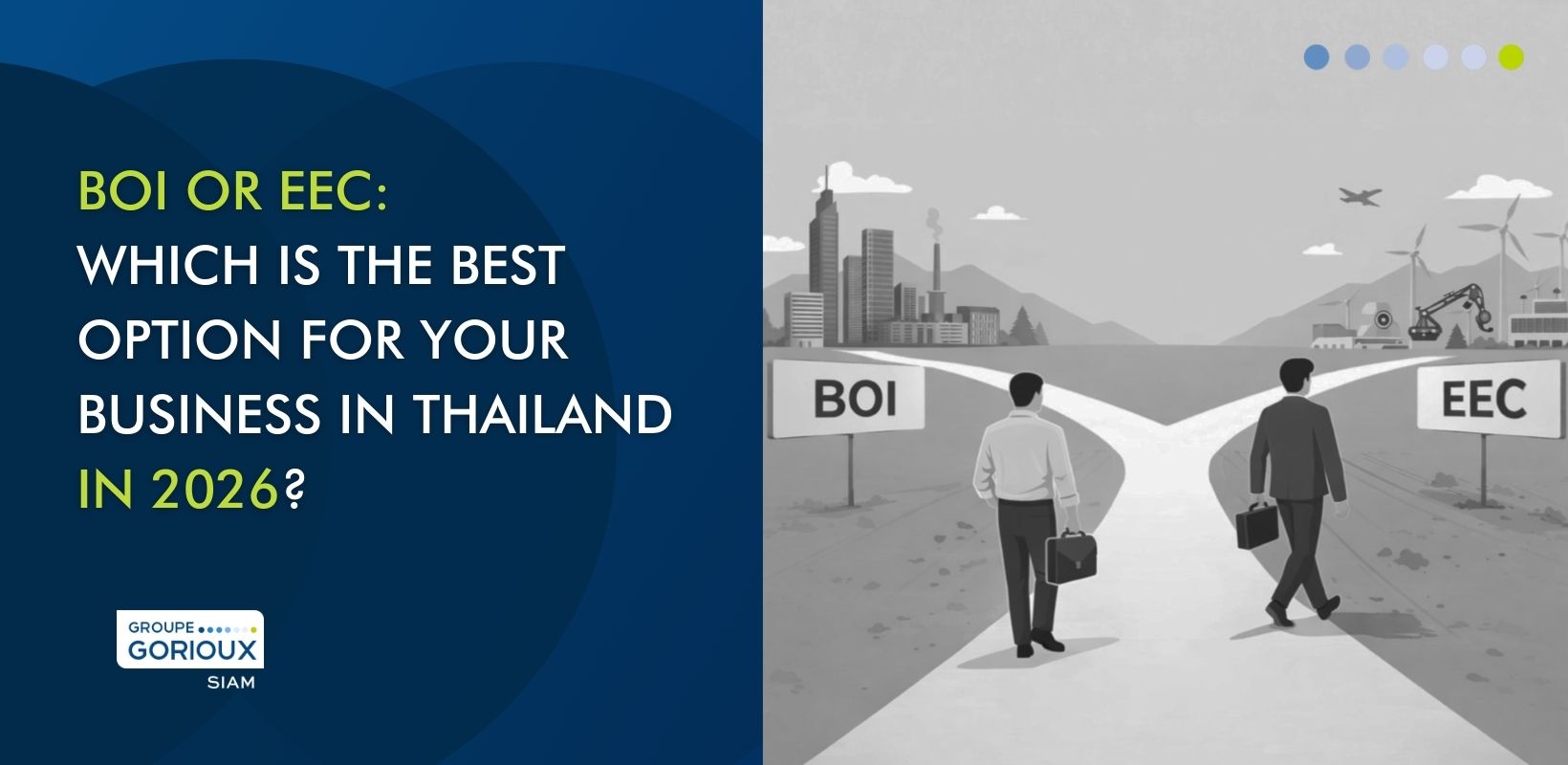
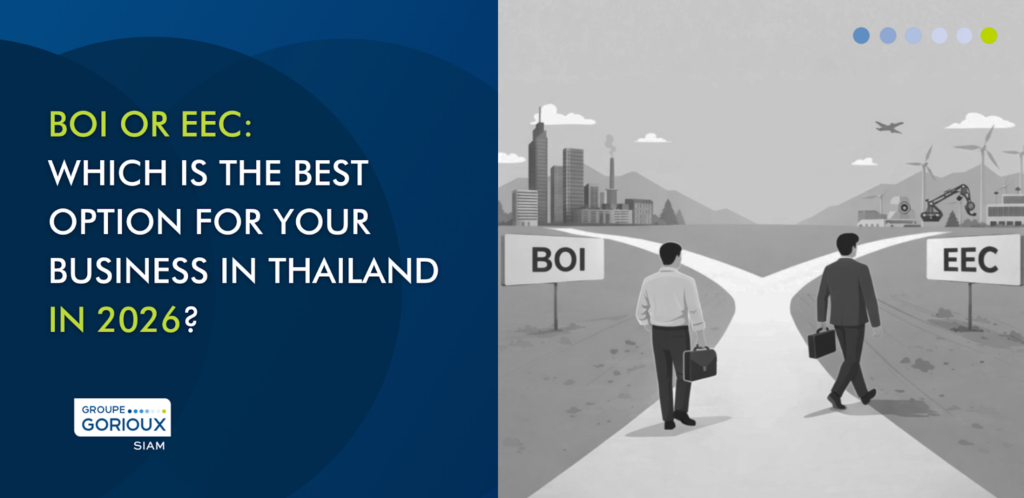
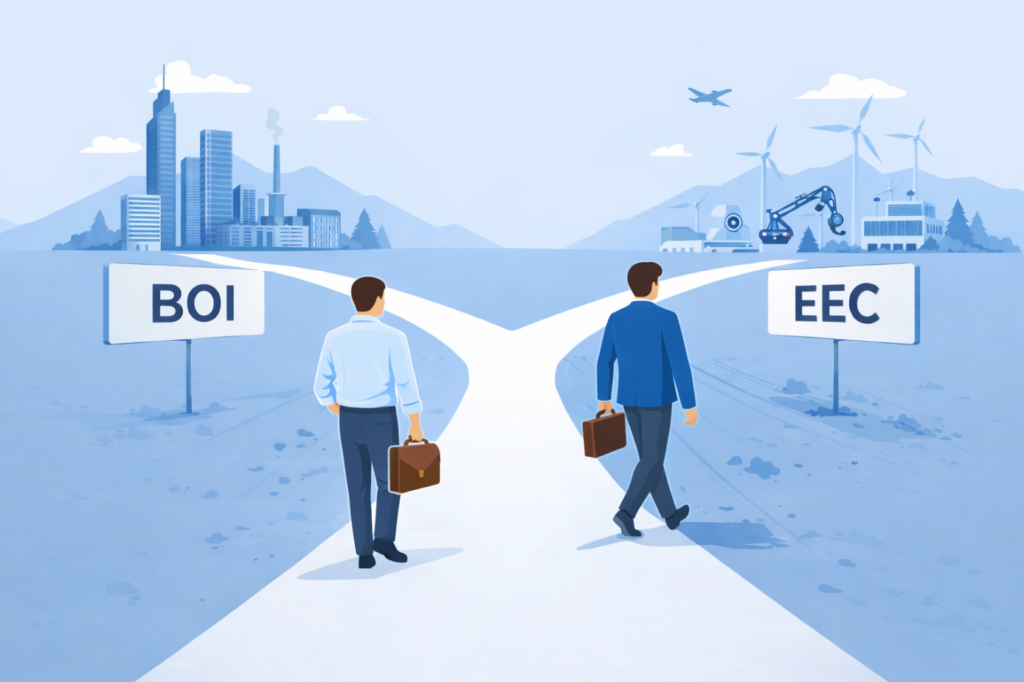
Two major frameworks play a central role in this strategy: the Board of Investment (BOI) and the Eastern Economic Corridor (EEC).
Both offer attractive incentives to foreign companies, including 100% foreign ownership and tax benefits. However, they are designed for different types of projects. Choosing between BOI and EEC depends mainly on your industry, location, and investment objectives.
This article explains the differences clearly to help you make the right decision in 2026.
1. BOI and EEC: Two government programs to attract investment
Both BOI and EEC are government initiatives aimed at stimulating foreign direct investment in Thailand.
They share several core benefits:
- 100% foreign ownership
- Corporate income tax incentives
- Import duty exemptions
- Simplified visas and work permits for foreign staff
However, their scope and focus are different:
- BOI applies nationwide and covers a wide range of industries.
- EEC targets advanced industries in a specific geographic area.
Your choice should be based on what you do, where you operate, and what incentives matter most to your project.
2. The BOI: Definition and objectives
The Board of Investment is Thailand’s main authority for promoting foreign and local investment.
Its primary role is to:
- Encourage strategic industries
- Reduce legal barriers for foreign companies
- Support economic development across the country
One key advantage of BOI promotion is the ability to bypass restrictions under the Foreign Business Act (FBA), which normally limits foreign ownership in many sectors.
BOI supports a broad range of activities, including:
- Manufacturing and industrial production
- Agriculture and food processing
- Digital, software, and IT services
- R&D, engineering, and innovation
- Certain service activities
3. Incentives and benefits offered by the BOI
A. Non-Tax Incentives
BOI-promoted companies may benefit from:
- 100% foreign ownership
- Simplified visas and work permits for foreign experts and employees
- Extended land ownership or long-term land use rights
- Authorization to operate businesses normally restricted to foreigners
- Official BOI certification recognized by Thai authorities
B. Tax Incentives
Depending on the project, BOI incentives may include:
- Corporate income tax exemption for up to 8 years
- Reduction or exemption of import duties on machinery
- Import duty exemptions on raw materials used for export
- Incentives scaled according to the project’s value and strategic importance
C. Eligibility
BOI eligibility depends on the activity, technology level, and economic contribution.
Eligible sectors include industry, agriculture, digital services, software, and more.
For activities not clearly listed, the TISO (Thailand Investment and Services Office) promotion may be an option.
Eligibility should always be confirmed through a project review with an investment expert.
4. The EEC: Definition and role in Thailand 4.0
The Eastern Economic Corridor is a special economic zone created to support Thailand’s transition toward high-technology and innovation-driven industries.
It covers three provinces: Chachoengsao, Chonburi and Rayong.
The EEC focuses on:
- Advanced technologies
- Infrastructure development
- Strategic industries with high added value
The EEC does not replace the BOI. Instead, it builds on BOI incentives, often offering enhanced benefits for qualifying projects located in the EEC area.
5. Eligible activities under the EEC program
EEC promotion targets specific industries, including:
- Next-generation automotive
- Smart electronics
- Advanced agriculture and biotechnology
- Future food
- Medical and premium tourism
- Digital technologies
- Automation and robotics
- Aviation and logistics
- Biofuels and biochemical industries
- Defense industries
- Education and human capital development
Projects outside these sectors are generally not eligible for EEC-specific incentives.
5. Incentives Offered by the EEC
A. Benefits for Companies
EEC-promoted companies may receive:
- 100% foreign ownership
- Corporate income tax exemption for up to 15 years
- Customs duty exemptions
- Government matching grants for certain R&D or innovation projects
- Priority access to infrastructure and industrial zones
B. Benefits for Foreign Employees
The EEC also offers a dedicated visa scheme:
- Automatic work permit
- Flat personal income tax rate of 17%
- Validity up to 10 years (multiple entry)
- Fast-track immigration at selected airports
These benefits are particularly attractive for companies relying on highly skilled foreign professionals.

7. BOI vs EEC: A practical comparison
Geographic Scope
- BOI: Available anywhere in Thailand
- EEC: Limited to three eastern provinces
Sector Coverage
- BOI: Wide range of industries and services
- EEC: High-technology and strategic industries only
Tax Incentives
- BOI: Project-based, up to 8 years
- EEC: Often more generous, up to 15 years
Flexibility
- BOI: More suitable for SMEs, service companies, and flexible setups
- EEC: Best for large-scale, technology-driven, or industrial projects
8. How to choose between BOI and EEC in 2026
To make the right choice, consider:
- Your business activity and whether it fits EEC target sectors
- Your intended location in Thailand
- The importance of tax incentives in your financial model
- Your need for foreign experts and long-term visas
- Your company size and long-term growth strategy
In many cases, BOI is sufficient. For advanced industrial or tech projects in the eastern region, EEC may provide stronger advantages.
Both BOI and EEC offer significant advantages but respond to different investment needs.
While BOI provides flexibility and nationwide coverage, EEC offers deeper incentives for highly strategic projects within a defined zone. A thorough preliminary analysis is essential to identify the most suitable framework and avoid costly mistakes.
Before launching or expanding your business in Thailand, seeking guidance to better understand these schemes and their implications is highly recommended.
Gorioux Siam supports foreign investors in structuring their projects and navigating the Thai business environment, helping them approach the right frameworks with clarity and confidence. Contact our team for a personalized discussion.